The recent passing of Kaicho Hatsuo Royama made us pause.
We did not know him personally, and it would not be our place to describe his life or define his legacy. We would like to express our sincere condolences to his family, students, friends and everyone who was close to him. Our thoughts are with them during this difficult time. Osu.
When someone who has carried and shaped Kyokushin knowledge for many decades is no longer there, it also raises a question that reaches far beyond one person or organisation:
What happens to the knowledge when the person carrying it is no longer there?
These moments do not only arise when someone passes away. A Sensei may retire, an instructor may move or a dojo may close. Sometimes a generation simply grows older, and knowledge that seemed permanently available becomes much harder to reach.
We often speak about preserving tradition. But what are we trying to preserve: movements, fighting experience, training methods, explanations, standards, values or ways of thinking? And must preservation keep them unchanged — or can passing knowledge forward also mean continuing to question and develop it?
There may not be one answer, but the question concerns every karateka.
Kyokushin knowledge lives in people
A syllabus can list techniques. A book can show the positions in a kata. A video can record a movement or kumite exchange in detail. But a significant part of Kyokushin knowledge is much harder to preserve.
It may be a small correction at exactly the right moment. An explanation of where power should travel. A particular rhythm within a kata. A subtle change in timing or distance during kumite. The ability to remain calm under pressure. A story after training that suddenly makes a principle understandable. Or standards and values repeated for years until they become part of how the students train, fight, teach and carry themselves.
Some of this knowledge can be explained, written down or recorded. Some is embodied: we understand it only after practising, feeling and being corrected again and again. And some may never have been put into words at all.
When a teacher is no longer present, part of their knowledge may also become harder to access — unless others carry it forward thoughtfully.
What does it actually mean to preserve a teacher's legacy?
Kyokushin itself gives us an extraordinary example.
When Sosai Mas Oyama passed away in 1994, Kyokushin entered a period of profound change. Today it continues around the world through organisations, instructors and lineages that share common roots while differing in structure, competition formats, grading requirements and some technical interpretations.
The purpose is not to judge those paths, but to ask:
What does it mean to continue the work of a teacher once the teacher can no longer answer the questions?
The same situation happens on a much smaller scale in ordinary dojos.
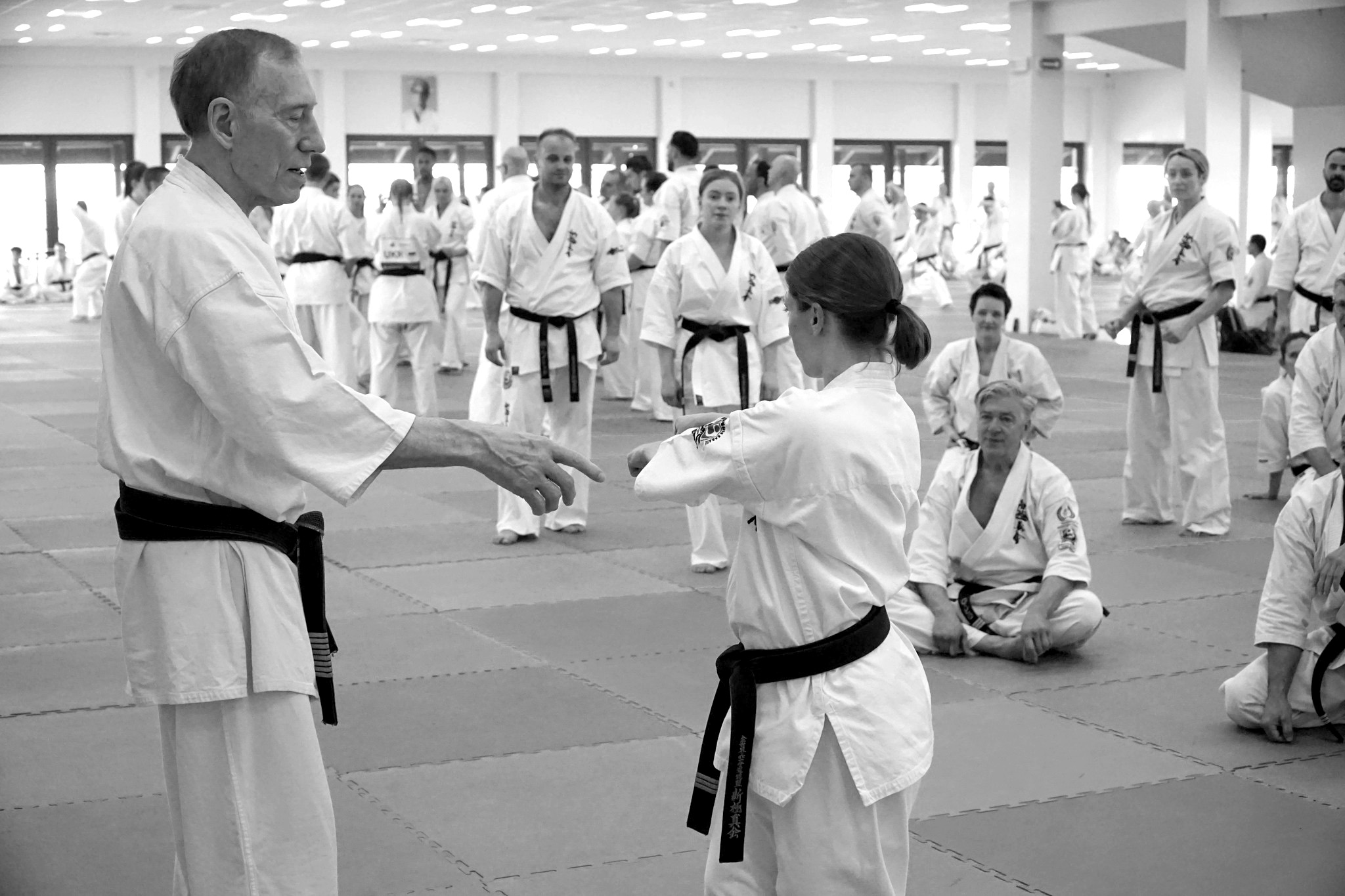
A Sensei teaches a particular detail for decades. One student learned it from them ten years ago; another learned it only recently. Both listened carefully, yet they were not necessarily taught the same thing.
A Sensei is also on a journey. They continue training, learning and exploring. Experience may deepen their understanding, change the words they use or even lead them to revise an earlier interpretation. What they teach today may therefore differ from what they taught a decade ago — not because either lesson was careless, but because their own Kyokushin has continued to develop.
A third student may remember the movement but not the explanation behind it. Years later, all three may sincerely say, “This is how Sensei taught it,” while demonstrating something different.
Which version is the tradition?
The question sounds almost theoretical until it happens in your own dojo.
Memory is not an archive
It is tempting to imagine knowledge passing neatly from teacher to student, unchanged from one generation to the next. Real learning is rarely that simple.
Students listen through their own experience. Their bodies and questions differ, and an explanation may gain new meaning as they grow. Teachers are changing too. Transmission captures not only a person, but a moment in that person’s journey.
This is not necessarily a failure of tradition. Kyokushin — and Karate more broadly — has always been carried by people, and people interpret, emphasise, develop and sometimes forget.
Documentation can reduce what gets lost. It cannot remove interpretation entirely.
Is preserving something the same as keeping it unchanged?
Perhaps this is the hardest part of the question.
If we change everything freely, techniques, training methods and fighting approaches may become disconnected from their principles until we use the same names while practising something quite different.
But if nothing may ever be questioned, tested or refined, Kyokushin becomes a snapshot. We may reproduce the outward form of what a teacher did without understanding why they did it.
And that leads to an uncomfortable thought:
Can copying a teacher exactly sometimes preserve the appearance of their Kyokushin while losing the thinking behind it?
A teacher may have spent a lifetime questioning and refining. If their students stop doing that in the name of tradition, are they truly following the teacher’s example?
There is no simple rule for where preservation should end and evolution should begin. Maybe the more useful goal is to understand what we are changing — and why.
Before we preserve knowledge, we should ask what kind of knowledge it is
Not everything we inherit has the same purpose.
A kata sequence, competition standard or grading syllabus may need consistency so karateka share a common framework. But an explanation of body mechanics can deepen, a kumite strategy may develop through new experience, a training method may change and an instructor may find a clearer way to help the next generation.
Even one part of our training can have several layers:
- the outward movement,
- the underlying principle,
- the application or intention,
- the timing, distance and decision-making under pressure,
- the teaching method,
- and the context in which it was taught.
They are related, but not identical. Knowing which layer we mean makes conversations about “the correct way” more meaningful.
How can karateka help knowledge survive?
Small habits can make a difference.
Ask why, not only how
Understanding the reason behind a correction makes it easier to carry forward than memorising the final position alone.
Record context, not just technique
A photograph preserves the shape of a stance. A note explaining what the instructor wanted to achieve preserves much more.
Be honest about the source
“This is how my Sensei taught it”, “this is our organisation’s standard” and “this is how I understand it” are different claims. Keeping that distinction visible lets knowledge evolve without quietly rewriting its history.
Pass on questions as well as answers
Sometimes a teacher gives us not a fixed solution, but a way of looking at a problem. Preserving that curiosity may matter as much as preserving the conclusion.
Can video preserve Kyokushin knowledge?
Yes — but only part of it.
Video can preserve movement, voice and explanations that would otherwise depend on memory. It can show technique, combinations, tactical ideas and moments from kumite. Books, diagrams and notes do the same differently. Future karateka can access material once available only in the same room.
But a recording cannot notice that your hip is out of position, feel why your timing breaks down under pressure, change its explanation or understand what you need at this point in your training. Nor can it fully preserve the trust, discipline, responsibility and human connection through which much of Kyokushin is passed on.
Documentation preserves knowledge. Teaching makes it personal.
We need both.
A question that sits close to dojoHUB
This is also one of the questions behind dojoHUB.
Every instructor carries years of corrections, fighting experience, training principles, values and ideas. Much of it lives on the tatami — in kihon, kata and kumite, but also in the way people train together, respond to difficulty and speak with one another.
Recording and structuring these perspectives is one way to help them travel further and remain accessible. It is not an attempt to define one final version of Kyokushin, and it cannot replace the relationship between Sensei and student.
Kyokushin is not carried by one voice alone. Instructors, organisations and karateka preserve different details and interpretations. Putting those perspectives beside one another can reveal the tradition’s depth.
Perhaps our task is to listen carefully, document thoughtfully and understand as deeply as we can. To remember where knowledge came from, be honest when we interpret it differently and pass it on with enough humility that the next generation can continue asking questions too.
No archive can preserve a teacher completely. A teacher lives on in the standards their students maintain, the questions they ask, the way they train and what they pass forward.
The knowledge does not remain unchanged. But it does not simply disappear either.
And maybe that leaves every karateka with the question that matters most:
What do we owe the people who taught us — to preserve what they gave us, or to continue developing it?